

Lead Generation for Contractors: Buying Leads vs. Generating Them
Angi, HomeAdvisor, Thumbtack — the true cost of shared leads and how contractors are winning by building their…
Read MoreConcrete is one of the hardest services to sell over the phone. A homeowner cannot picture a finished driveway from a verbal description, and a property manager cannot judge your flatwork from a business card. That is why website design for concrete contractors has to do a different job than a generic contractor website: it has to show proof. When buyers can see your finished work, organized by the type of project they are planning, your site stops being a brochure and starts being your best salesperson.
Most concrete company websites fail at this in predictable ways. One page tries to cover driveways, patios, foundations, and commercial work all at once. The photos are a handful of unlabeled images, or worse, stock photos of someone else’s pours. The buyer shrugs, clicks back to Google, and calls the next company whose work they can actually see.
This guide covers what a concrete website needs to book more estimates: service pages that match how buyers search, galleries that prove your quality, an estimate path that makes quoting easier, and trust signals that answer buyers’ questions before they call.
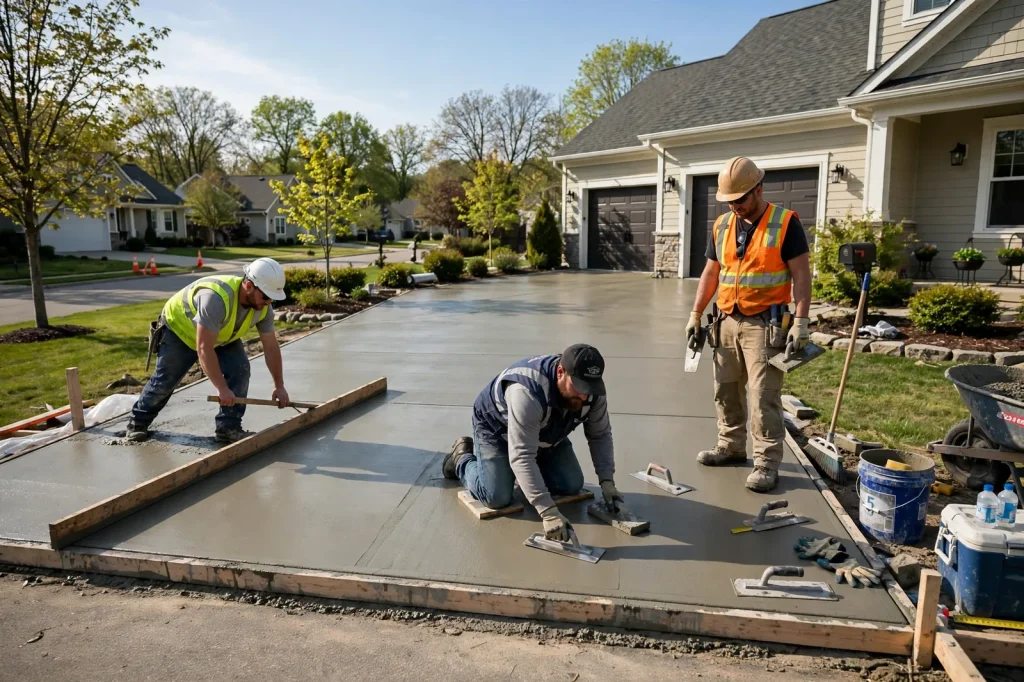
Website design for concrete contractors works when the site is built around proof: a separate page for each service you sell, photo galleries of your real finished work, a simple estimate request path that lets buyers send photos of their job site, and clear trust signals like licensing, insurance, reviews, and service areas. Built this way, the site ranks better on Google and converts more visitors into estimate requests, because buyers can see exactly what they are hiring you to do. In short, website design for concrete contractors is about proof, clarity, and an easy path to an estimate.
Concrete buyers are buying something they cannot fully evaluate until it cures. They have usually seen bad work in their own neighborhood: cracked driveways, uneven patios, flatwork that puddles after rain. Their biggest fear is paying for a job that looks fine on day one and fails in year two. Your website either calms that fear or feeds it.
A generic site feeds it. Vague claims about quality and experience are easy to type and impossible to verify. A proof-based site calms it, because every page answers the buyer’s real question: “Can this company do my specific project, and can I see how their work turns out?”
In short, website design for concrete contractors work best when every page makes it easy for a visitor to request an estimate.
That is also why your website is the hub of your whole strategy. Everything in your concrete contractor marketing points back to it: ads, searches, and referrals all end with a buyer on your site, deciding in seconds whether you look like the right company.
The single biggest improvement in website design for concrete contractors is structure. Each service you want to sell deserves its own page, written for the buyer of that specific project. A homeowner replacing a driveway and a builder looking for foundation work have different budgets, questions, and search terms. One blended page serves neither of them well, and Google cannot tell what it is really about either.
Your driveway page should speak to homeowners: tear-out and replacement, thickness and reinforcement explained in plain language, drainage and slope, and finish options. Photos of completed driveways do more selling than any paragraph.
Decorative work is visual, so this page should be your most photo-heavy. Stamped and colored finishes, borders, steps, and walkways each deserve gallery space. Buyers for this work are comparing aesthetics, so show range: different patterns, colors, and yard sizes.
Foundation buyers, often builders and serious homeowners, care about precision and process. This page should explain your forming, reinforcement, and inspection-readiness approach in straightforward terms, and the types of projects you take on. Keep the language factual and specific to your actual process.
Property managers and general contractors think in terms of scope, scheduling, and reliability. A dedicated commercial page should cover parking lots, sidewalks, pads, and repair work, plus practical details like insurance documentation, scheduling around business hours, and phased work. That is the standard website design for concrete contractors should be built to: every page answers a real buyer’s question.
Concrete is a visual trade, and your galleries should be built from your real jobs. Stock photos are worse than no photos: the moment a visitor suspects your gallery is not your work, every other claim on the site becomes suspect.
A few habits make galleries work harder:
Photos also make your estimates better. Build an estimate request form that lets buyers upload photos of their current driveway, patio area, or lot, along with rough measurements if they have them. You see the site conditions before you call back: access, slope, tear-out needs, and scope, so the first conversation is better informed and your time goes to serious buyers.
Proof gets a buyer interested. Trust signals get them to pick up the phone. Every concrete website should make the following easy to find, not buried:
These elements also strengthen the lead generation campaigns that bring buyers to your site in the first place. Your website is not one channel among many; it is where every channel lands.
Most of your visitors will meet you on a phone. Homeowners search from their driveway while staring at the cracks in it, and commercial buyers search between job sites. If your pages load slowly, pinch and zoom awkwardly, or bury the call button, you lose the very buyers your marketing worked to attract. Fast load times and tap-to-call buttons are not technical niceties; they are sales features.
The same structure that helps buyers helps Google. When you invest in professional website design with separate pages for each service, every page can be optimized for the searches that match it: the driveway page for driveway searches, the patio page for patio searches, and so on. The site becomes a set of precise answers to precise local searches instead of one vague page hoping to rank for everything.
Contractors Marketing Pros is a marketing agency that works exclusively with contractors in the United States, serving clients remotely from Miami, Florida. Our Website Design service builds sites to do one job: turn visitors into booked estimates. Our approach to website design for concrete contractors means site structure that separates your services properly, galleries that showcase your real work, and estimate paths built for how concrete actually gets quoted.
The service covers the full build: planning the pages your buyers need, writing them in plain language, and setting up the technical foundation so the site loads fast and is ready to rank. If your current site is a single page trying to sell every service you offer, we can rebuild it into an asset that sells while you are on the slab. Our website design for concrete contractors is built to turn your project photos into booked estimates.
Resource: American Concrete Institute
At least one page for each service you actively want to sell. For most concrete companies that means dedicated pages for driveways, patios and decorative work, foundations, and commercial flatwork. Each page targets that buyer’s searches with exactly the proof they need. Most projects start with an audit, because website design for concrete contractors depends on what your current site already does well.
Your own photos matter, and stock photos can actively hurt you. Buyers choose concrete companies based on finished results, and they quickly distrust a gallery that looks generic. Real project photos organized by job type, with short captions, give buyers confidence to request an estimate.
Ask for the essentials: contact details, the type of project, a short description, and the option to upload photos of the site. Site photos help you judge access, condition, and scope before the first call. Keep the form short so buyers actually finish it.
Yes, when the site is structured properly. Separate service pages, clear service-area information, fast mobile loading, and descriptive titles and photo descriptions give Google precise pages to match to precise local searches. That structure is the core of website design for concrete contractors that both ranks and converts.
As fast as reasonably possible, ideally within a couple of seconds. Buyers will not wait on a slow page when three competitors are one tap away. Compressing photos, using modern hosting, and keeping page design clean are the main levers.
If you want website design for concrete contractors that sells the work as well as your crews pour it, call Contractors Marketing Pros at (813) 214-1035, message us on WhatsApp, or send a request through our contact page. We will look at your current site and show you exactly what we would change first. If you want website design for concrete contractors that sells your work while you pour, start with a free marketing audit.
Angi, HomeAdvisor, Thumbtack — the true cost of shared leads and how contractors are winning by building their…
Read More
Every time a hailstorm rolls through Dallas–Fort Worth, thousands of homeowners grab their phones and search for a…
Read More
A remodel is one of the biggest purchases a homeowner makes, and one of the longest relationships they…
Read More