
How to Turn Your Asphalt Paving Website Into a Lead Generator
Your asphalt paving website should be your hardest-working salesperson. But for most paving companies, the website just sits…
Read MoreSocial media marketing for contractors works when it does one thing well: it turns strangers into people who trust you enough to call. A homeowner rarely hires a contractor because of one clever post. They hire the company whose work they have already seen and whose past customers seem happy. Social media is where that familiarity gets built — long before the homeowner ever needs a quote.
That is the real job of a contractor’s social media presence: not going viral or collecting followers, but making your company the obvious, safe choice when a roof leaks or a driveway needs replacing.
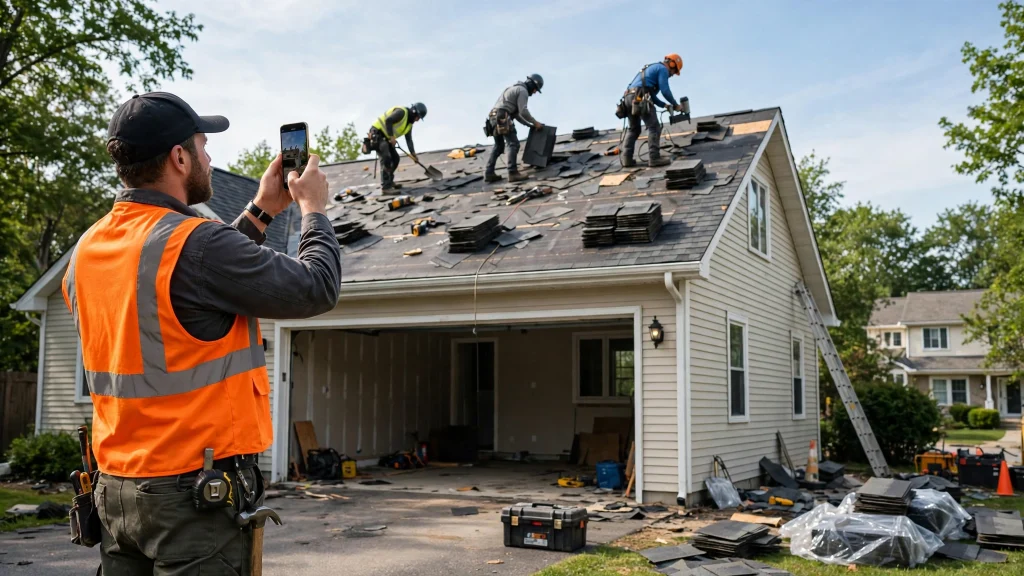
The Short Answer: Social media marketing for contractors books jobs when it consistently shows real proof of work — job photos, before-and-after results, short job-site videos, and customer testimonials — on the platforms homeowners actually use, with an easy way to get in touch in every post. Followers alone book nothing; visible proof plus a clear next step turns scrolling into scheduled estimates.
You do not need to be everywhere. Most contractors get better results from doing two platforms well than from spreading thinly across six.
Facebook comes first for most trades. It is where local homeowners ask neighbors for recommendations, join community groups, and check a company before calling. A complete Facebook business page — service area, phone number, photos of real jobs, and reviews — acts as a second website for many customers, and recommendation requests in your town’s Groups often come from people ready to hire soon.
Instagram comes second, and it is the visual proof platform. Before-and-after photos, short reels from the job site, and finished-project galleries all perform naturally here. Homeowners deciding between two contractors compare Instagram feeds the way they used to compare photo albums — and real, recent work beats stock photos every time.
YouTube earns trust over time. You do not need a polished channel. Short, honest videos — how you prep a roof before shingling, or what a homeowner should expect during a remodel — answer the exact questions people type into search, and keep working long after you post them.
Nextdoor deserves attention for local trades. It is built around neighborhoods, and its recommendation threads carry unusual weight because they come from nearby residents.
Pick Facebook and Instagram as your foundation. Add YouTube or Nextdoor once those two are running consistently. Paid advertising can amplify good organic content later, but it cannot fix an empty or unconvincing organic presence.
Resource: Meta for Business
Homeowners hire based on confidence, and confidence comes from evidence. Four types of posts carry most of that weight.
Social media marketing for contractors should lead with proof, not promotions.
Job photos — real ones, taken on real job sites. A finished driveway, a repaired roofline, a remodeled bathroom: these are your portfolio, and social media is where most homeowners will actually see it. Photograph in good light, from angles that show the result clearly, and caption with what was done and the town or neighborhood (never a customer’s address). Photos of a tidy crew at work say as much about your company as the finished result.
Before-and-after posts. Nothing explains value faster than a side-by-side comparison. A stained, cracked patio next to the same patio restored tells the whole story in seconds. Keep the format consistent — same angle, same lighting where possible — so followers recognize your transformations.
Short job-site videos. You do not need editing skills or expensive equipment. A 30- to 60-second phone video explaining what is happening and why feels more honest than any polished ad. For example, a paving contractor might film a quick clip explaining why a base layer matters before asphalt goes down. Customer testimonial videos belong here too: a homeowner speaking in their own words is the most persuasive content a contractor can publish.
Helpful, plain-language posts. Answer the questions homeowners actually ask: how long does this project take, what affects the cost range, what should they check before hiring. Posts like these position you as the expert in your trade, and they get saved and shared — putting your name in front of people who are not following you yet.
The most common reason contractor social media fails is not bad content — it is silence. A page that posts three times in one week and then nothing for two months looks abandoned.
Consistency does not mean posting every day. It means posting on a schedule you can actually keep. For most contractors, three to four posts a week is plenty, and two genuinely good posts a week beats five rushed ones. Homeowners who see your work regularly start to feel they know your company, and that familiarity is what makes them call you first.
Social media marketing for contractors rewards a rhythm you can sustain.
Batch content around real work: on a job, take ten photos and two short videos. That one visit can supply a week’s posts — a progress photo, a before-and-after, a short explainer video, and a completed-project gallery. Caption them simply: what the job was, what problem it solved, and what to do next if the reader has the same problem. For quiet weeks, save finished-project photos and keep a short list of evergreen topics — seasonal maintenance tips, what to look for in a quote — to fill gaps.
Attention is not revenue. The gap between a follower and a booked job is crossed by making contact effortless and responding quickly.
Social media marketing for contractors works when the next step is obvious.
Make your profiles work like a storefront: phone number, service area, and a link to your website or contact page, visible without digging. A homeowner who has to hunt for a phone number will often just call the next contractor instead.
End posts with a clear next step. “Message us for a free estimate” tells the reader exactly what to do; vague endings like “Let us know what you think!” invite comments, not inquiries.
Treat messages and comments as leads. A homeowner asking about a service is raising their hand — reply promptly, answer honestly, and move the conversation to a phone call or estimate request. Slow replies lose jobs to faster competitors.
Finally, connect social media to the rest of your marketing: your website should show the same projects, your Google reviews should be easy to find, and your estimate process should be simple once someone reaches out.
Social media marketing for contractors works best when every channel points to the same next step.
Posting only promotions. A feed that is nothing but “Call now!” trains people to ignore you. Promotions work as the exception — most content should prove your value, so the occasional offer lands with an audience that already trusts you.
Using stock photos instead of your own work. Homeowners can tell, and it undermines a local contractor’s one advantage: real, nearby, verifiable work. If you have no photos of a service yet, post a process explanation or testimonial instead.
Posting without location or service signals. If your captions never mention your trade or service area, neither followers nor platform algorithms will connect you with local homeowners looking for exactly what you do. Name the service and town naturally — as plain information, not keyword stuffing.
Buying followers or engagement. Inflated counts impress nobody who matters, and they damage your reach: platforms show your posts to a percentage of your audience, and fake followers who never engage drag that percentage down. A thousand real local followers are worth far more than ten thousand strangers.
Ignoring comments and messages. Every unanswered question on your page is a public signal about your customer service. Even a short, helpful reply — plus a pointer to your phone number — protects your reputation.
Expecting overnight results. Social media compounds. The first month builds the habit and the portfolio; inquiries usually follow once a homeowner has seen your work several times. Contractors who quit after three quiet weeks never reach the payoff phase.
Social media marketing for contractors compounds when proof keeps appearing.
Running consistent, professional social media takes time that most contractors would rather spend on job sites. That is where an agency earns its place — by handling the marketing so the contractor can handle the work.
Contractors Marketing Pros helps contractors turn social media into booked jobs in three connected ways. Facebook and Instagram advertising puts your best proven content — real job photos, testimonials, and offers — in front of homeowners in your service area. Lead generation ties that attention to a simple path to an estimate request, so interest becomes inquiries instead of just likes. And Google reviews management makes sure the trust you build on social media is backed up where homeowners check next: your review profile, which many customers read before they ever call.
The agency works with contractors remotely across the United States. If social media is an afterthought in your business, handing it to a team that does it daily is often the difference between a page that exists and a page that books work.
How often should a contractor post on social media? Three to four posts a week is a strong target, and two high-quality posts beats five rushed ones. What matters most is a schedule you can maintain for months — consistency builds familiarity and trust.
Social media marketing for contractors builds familiarity over time.
Which social media platform is best for contractors? Facebook is usually the best starting point, because it is where local recommendation requests happen and where homeowners check a company before calling. Instagram is the best second platform for visual trades, since before-and-after photos and short job-site videos show your work directly.
Can social media replace my website or Google presence? No. Social media builds familiarity, but homeowners still check your website and your Google reviews before hiring. Think of it as a system: social media introduces your company, your website captures estimate requests, and your reviews confirm your reputation.
How long does it take for social media marketing to bring in jobs? It varies by trade, market, and consistency, and no honest marketer can promise a fixed timeline. Expect the first weeks to build your portfolio and rhythm, with inquiries following once homeowners have seen your work repeatedly.
Should I run paid ads, or is posting organically enough? Organic posting is the foundation — it proves your work and builds trust. Paid ads work best as an amplifier of content that already performs well organically. Running ads on top of an empty organic presence wastes budget, so fix the organic presence first.
Your next customer is already scrolling. The question is whether they will see your work, trust your company, and know how to reach you — or scroll past to a competitor.
If you want help building a social media presence that generates inquiries, talk to Contractors Marketing Pros. Call +1 (813) 214-1035, message us on WhatsApp, or reach out through the contact page.
Your asphalt paving website should be your hardest-working salesperson. But for most paving companies, the website just sits…
Read More
When a homeowner needs a new driveway, they rarely call the first paving company they find. They compare…
Read More
If you run a general contracting company in Austin and your competitors keep showing up in Google Maps…
Read More